Excel ATO Logbook Template (XLSX)
A flexible ATO Compliant logbook workbook for tracking business mileage in Microsoft Excel.
Download Excel template
If you are an Australian taxpayer who uses your own car for work-related trips, you may claim a deduction for car expenses.
You use either of the Logbook method or the Cents per kilometre method to calculate deductions for car expenses.
Sole traders and some partnerships can also use the logbook method when claiming expenses for a car.
The Australian Taxation Office (ATO) requires you to keep accurate records to substantiate your claim.
In Australia, the term “logbook” or "log book" generally refers to a record of vehicle usage for tax purposes. It is referred to by the Australian Taxation Office (ATO) as a logbook method for claiming expenses. A valid logbook must be kept for 12 weeks to determine business-use percentage, allowing deductions for fuel, repairs, and depreciation over 5 years.
Yes, you can claim work-related car expenses in Australia without a logbook using the Cents per kilometre method for up to 5,000 business kilometres per car, per year.
No receipts are needed, but you must be able to clearly show how you calculated your work-related kilometers. You also do need to be able to show that you own the car.
The Australian Taxation Office (ATO) lists the following requirements for keeping a logbook:
The logbook must cover at least 12 continuous weeks and be broadly representative of your travel. You need to include:
Although the logbook is valid for 5 years, the ATO have specific additional requirements: the logbook is representative of your work-related use.
Prefer to work in a spreadsheet or on paper? You can use these templates with or without the Trip Logbook app. They follow the same field structure used in Trip Logbook exports.
A flexible ATO Compliant logbook workbook for tracking business mileage in Microsoft Excel.
Download Excel templateA printable ATO Compliant logbook for glove‑box or office use.
Download PDF templateThe Trip Logbook App can record your business and private kilometers automatically. Using the App, you can produce your vehicle logbook report in the required ATO Compliant Logbook format. You can also export the logbook to CSV format. The CSV file can be opened in Microsoft Excel, Google Sheets or Apple Numbers.
 Automatically track your vehicle mileage using your phone.
Capture your fuel, oil, repairs and maintenance costs.
Add, edit or delete trips at any time.
Review your logged trips and confirm trip details.
Quickly find all unconfirmed trips using the rich filter feature.
Instantly view the Business vs Private KM ratio using Trip Summary.
Export your trips to CSV and open in your favourite spreadsheet app for deeper analysis and custom formatting.
Export your trips directly to the required ATO Compliant Logbook PDF format.
Trip Logging will not be interrupted by network connection failures.
Backup your logged trip data whenever and as often as you like, using the backup and CSV export features.
Automatically track your vehicle mileage using your phone.
Capture your fuel, oil, repairs and maintenance costs.
Add, edit or delete trips at any time.
Review your logged trips and confirm trip details.
Quickly find all unconfirmed trips using the rich filter feature.
Instantly view the Business vs Private KM ratio using Trip Summary.
Export your trips to CSV and open in your favourite spreadsheet app for deeper analysis and custom formatting.
Export your trips directly to the required ATO Compliant Logbook PDF format.
Trip Logging will not be interrupted by network connection failures.
Backup your logged trip data whenever and as often as you like, using the backup and CSV export features.


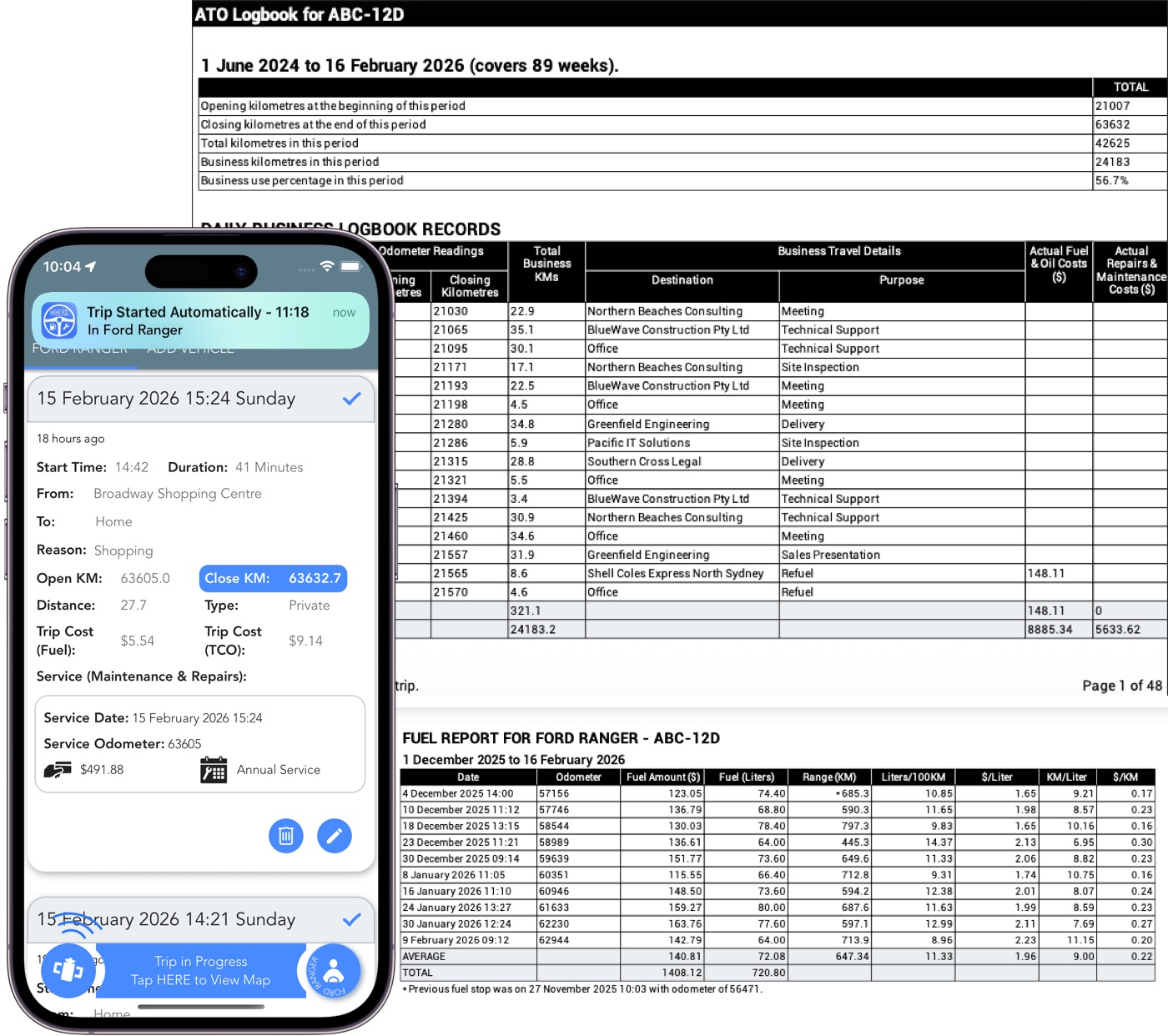
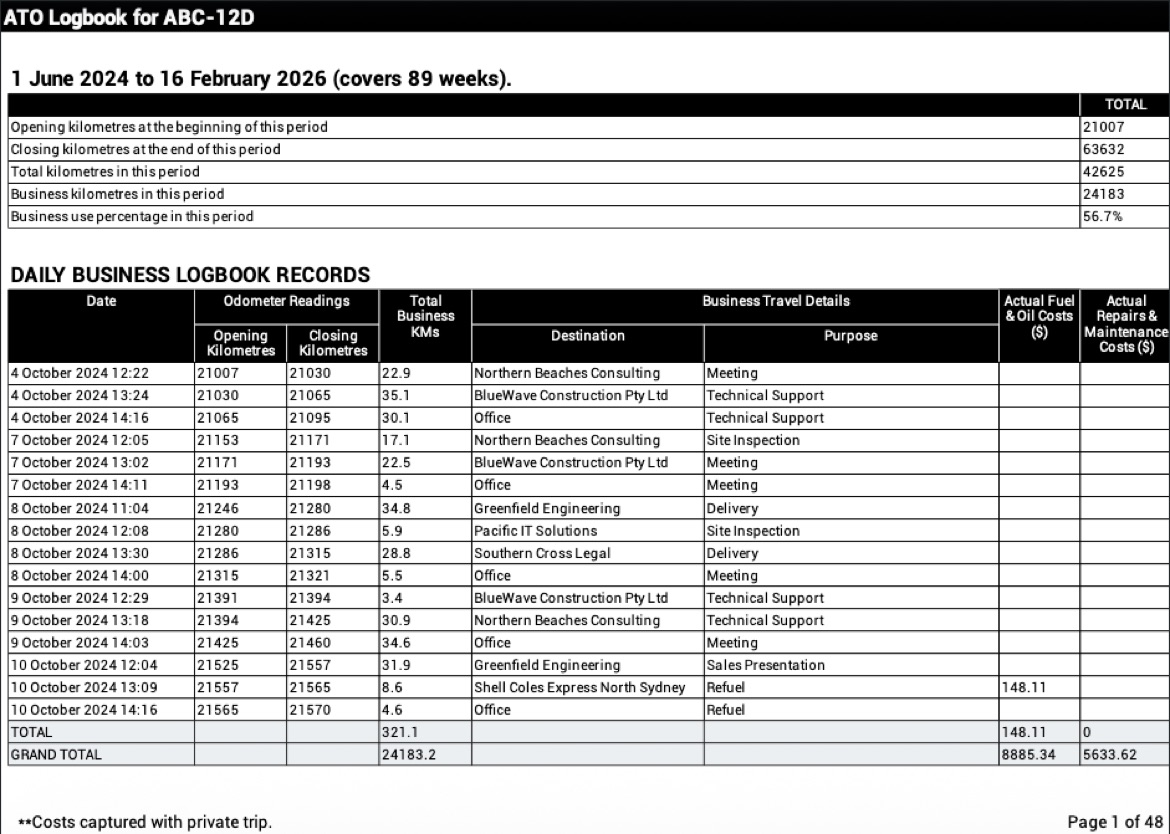
This is an example of a completed ATO Logbook exported from the Trip Logbook App.
The information on this page is provided for general educational purposes only and should not be regarded as tax advice. ATO rules, rates, and enforcement practices may change over time and can differ based on individual circumstances. Always consult official ATO publications or a qualified tax professional to confirm current requirements. Avoid relying solely on summaries or third‑party interpretations.